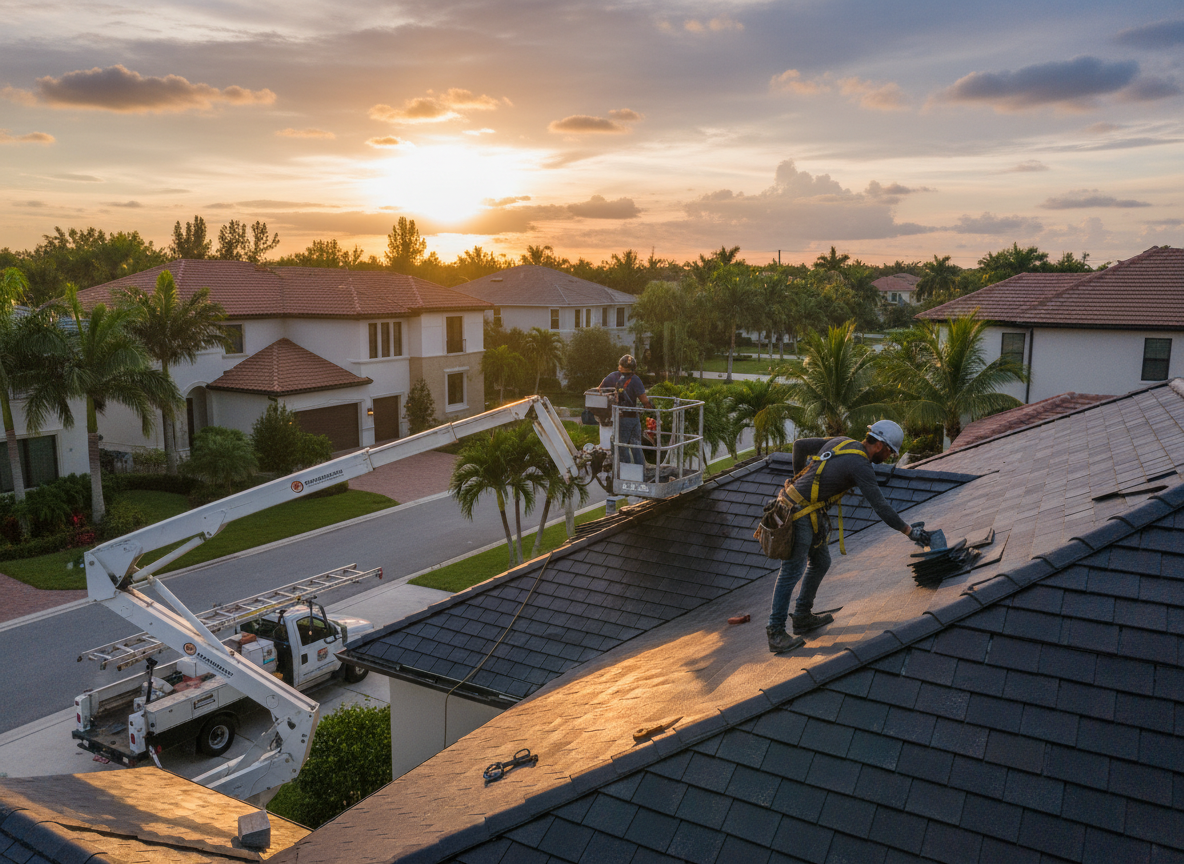
Coconut Creek homes built from the 1970s through the 1990s commonly feature asphalt shingles or concrete tile roofs that must withstand repeated heavy downpours and high winds. Afternoon thunderstorms can drive water under lifted shingles or cracked tiles, especially where original flashing has corroded. Broward County requires updated wind-load standards on any roof section exceeding 25 percent replacement, so contractors routinely check for proper hurricane straps and sealed decking during every service call.
Heat and UV exposure in this area accelerate granule loss on shingles and fade tile coatings faster than in northern Florida. Homeowners often overlook ponding on low-slope sections near pool cages or lanais, which leads to deck rot if left unaddressed. Local crews carry extra sealant and underlayment rated for 140 mph winds because sudden gusts during the rainy season can turn minor leaks into interior damage within hours.
Edge cases include older Wynmoor and Winston Park neighborhoods where tree cover drops debris that clogs valleys and promotes algae growth. Metal drip edges installed without proper overlap allow wind-driven rain to enter at the eaves. Crews routinely photograph existing ventilation and insulation before starting so homeowners see exactly why ridge vents or additional baffles may be needed to meet current energy code expectations.
Technician insight
In Coconut Creek, the thing that catches most people out with Best Roofing Contractor is how quickly afternoon storms push water under the original 1980s flashing on tile roofs in neighborhoods like Winston Park; once the underlayment fails, interior ceilings stain within a single season even though the tiles themselves still look fine.
Post-Storm Flashing Repair
A Coconut Creek homeowner reported ceiling stains after several heavy rains. Inspection revealed lifted flashing around a bathroom vent on a 1987 tile roof. Crew replaced the flashing, added new sealant rated for high winds, and verified deck integrity. No further leaks occurred during the next rainy season.
How it works
- 1
Initial Inspection
Technician climbs the roof and checks every slope, valley, and penetration for damage while documenting conditions with photos.
- 2
Detailed Assessment
Report covers material condition, code compliance items, and any Broward County permit requirements before work begins.
- 3
Material Selection
Recommendations focus on products proven to handle Coconut Creek humidity, UV, and wind loads.
- 4
Execution and Cleanup
Work proceeds with daily debris removal and final walkthrough to confirm all penetrations are sealed.
Pricing
Upfront written estimates provided before any work starts, with options clearly separated by scope.